
Lost Payslips: Complete Recovery Guide for UK Workers 2026
Imagine standing at your mortgage advisor's desk, paperwork spread before you, only to realise the three crucial months of wage records have vanished. Or picture yourself preparing a tax rebate claim, searching frantically through folders, finding nothing but emptiness where your payslip collection should be. These scenarios haunt countless UK employees annually.
Lost payslips represent more than mere administrative inconvenience — they can derail life-changing financial decisions, delay essential benefits, and create legal headaches that might have been avoided. Yet many workers remain unaware that systematic recovery pathways exist. This comprehensive guide illuminates every available route for retrieving missing wage documentation in 2026, whether you're a current employee, former worker, or employer managing staff records.
Note: If you urgently need your Payslips, P60, or P45 and cannot wait for standard replacement requests through your employer or HMRC, Payslips P60 offers accelerated document retrieval services. Visit: A2Z Payroll to request your documents — within 2 hours, A2Z Payroll has over 20 years' experience, in providing genuine payroll documentation.
Contents
Why Your Payslips Matter More Than You Think
A payslip functions as the financial fingerprint of your employment relationship. Unlike generic bank statements, lost payslips contain itemised breakdowns that reveal your exact taxable income, deduction categories, and employment terms — information irreplaceable through other means.
Legal Framework Underpinning Payslip Rights
The United Kingdom maintains some of the world's most robust worker protection legislation regarding payslips. Since April 2019, the Employment Rights Act mandates that all workers receive itemised written documentation detailing:
- Total hours worked (for hourly-paid staff)
- Hourly rate where applicable
- Gross earnings before any deductions
- Variable deductions including Income Tax and National Insurance
- Fixed deductions presented individually or as grouped totals
- Net pay received after all withholdings
Violations trigger enforcement powers. Workers may file complaints at employment tribunals, where successful claims result in compensation awards. Official government guidance resides on the HMRC portal outlining both rights and remedies.
Real-World Scenarios Demanding Payslip Evidence
Financial institutions, government agencies, and private organisations increasingly mandate documentary proof of income. Understanding which situations require lost payslips helps prioritise retrieval efforts:
| Scenario | Required Documentation | Typical Timeframe Needed |
|---|---|---|
| Mortgage approval | Last 3 monthly payslips plus P60 | Current year + previous tax year |
| Private rental application | Recent payslips or employer letter | Last 2-3 months minimum |
| Personal loan | Payslips demonstrating affordability | 3-6 months consecutive |
| Visa extension | Salary proof plus bank statements | 6-12 months depending on visa type |
| Tax code correction | Historical payslips showing errors | All affected tax years |
Quick answer: The fastest way to get your lost payslips is usually your employer's payroll portal or HR team. If that's not possible — for example, the company has closed — HMRC can supply your employment and income history instead. Also explore our main Lost Payslips landing page for additional options.
Six Proven Recovery Methods Ranked
"Where can I find my missing wage statements?" — this search query dominates Google's autocomplete suggestions. Below ranks every viable recovery avenue from most to least effective.
Method 1: Direct Employer Contact (Success Rate: 85%)
Your organisation's payroll team retains digital records indefinitely in most cases. Modern payroll platforms including Sage, Xero, QuickBooks Payroll, and BrightPay archive payslip data permanently unless actively deleted.
Pro Tip: Structure your request email professionally. Include full name, employee reference number, National Insurance number, employment dates, and precisely which pay periods you require. This eliminates back-and-forth correspondence accelerating resolution.
Response expectations vary:
- Current employers: Typically reply within 24-48 hours
- Former employers: Allow 5-10 working days
- Large corporations: May route through HR departments requiring 10-15 days
- Small businesses: Often faster but less organised record systems
Method 2: Self-Service Portal Retrieval (Success Rate: 70%)
Approximately 60% of UK employers now utilise employee-facing payroll portals. Forgotten credentials plague many workers who never actively saved login information.
Recovery strategies include:
- Attempting standard "Forgot Password" functionality
- Contacting IT helpdesk for account reactivation
- Checking archived emails for original welcome messages containing temporary passwords
- Inquiring whether offline backup downloads exist locally
Method 3: HMRC Personal Tax Account Access (Success Rate: 60%)
Though HMRC cannot supply actual payslip copies, their Personal Tax Account reveals aggregated PAYE data matching what appears on your lost payslips. Navigate to gov.uk/sign-in-personal-tax-account to view:
- Annual income summaries aligned with tax years
- Employment start and cessation dates
- Income Tax deducted throughout each period
- National Insurance contributions history
- Real-time information submissions from employers
For deeper technical details regarding PAYE record retention, consult the HMRC PAYE Technical Manual section 11035.
Method 4: Bank Statement Cross-Reference (Success Rate: 45%)
Electronic bank transfers leave indelible trails. Download 12 months of transaction history highlighting salary deposits. While lacking deduction breakdowns, banks provide independent verification of gross earnings received.
Method 5: Third-Party Reprint Services (Success Rate: 30%)
Caveat emptor applies strongly here. Fraudulent operators routinely advertise payslip generation services producing documents bearing no official employer validation. Financial institutions increasingly detect and reject fabricated paperwork.
Legitimate considerations include:
| Factor | Risk Assessment |
|---|---|
| Pricing transparency | Red flag if quoted below £5 per document |
| Data security protocols | Verify GDPR compliance before sharing NI numbers |
| Acceptance guarantees | Any provider claiming universal acceptance likely misleading |
| Company registration | Check Companies House for legitimate business status |
Method 6: Subject Access Request Under GDPR (Success Rate: 20%)
When cooperation fails, invoke Article 15 of the UK GDPR. Submit written Subject Access Requests compelling organisations to disclose personal data held including payroll records. Employers must respond within one calendar month without charge.
Limitations exist:
- Companies beyond administration cannot comply
- Requests targeting excessive periods may face refusal
- Third parties mentioned within documents get redacted
- Enforcement requires Information Commissioner's Office intervention
Visual Reference: Recognising Valid Payslip Layouts
Understanding standardised document structures empowers accurate identification of authentic versus forged lost payslips. Examine the accompanying illustration displaying contemporary UK payroll formatting conventions.
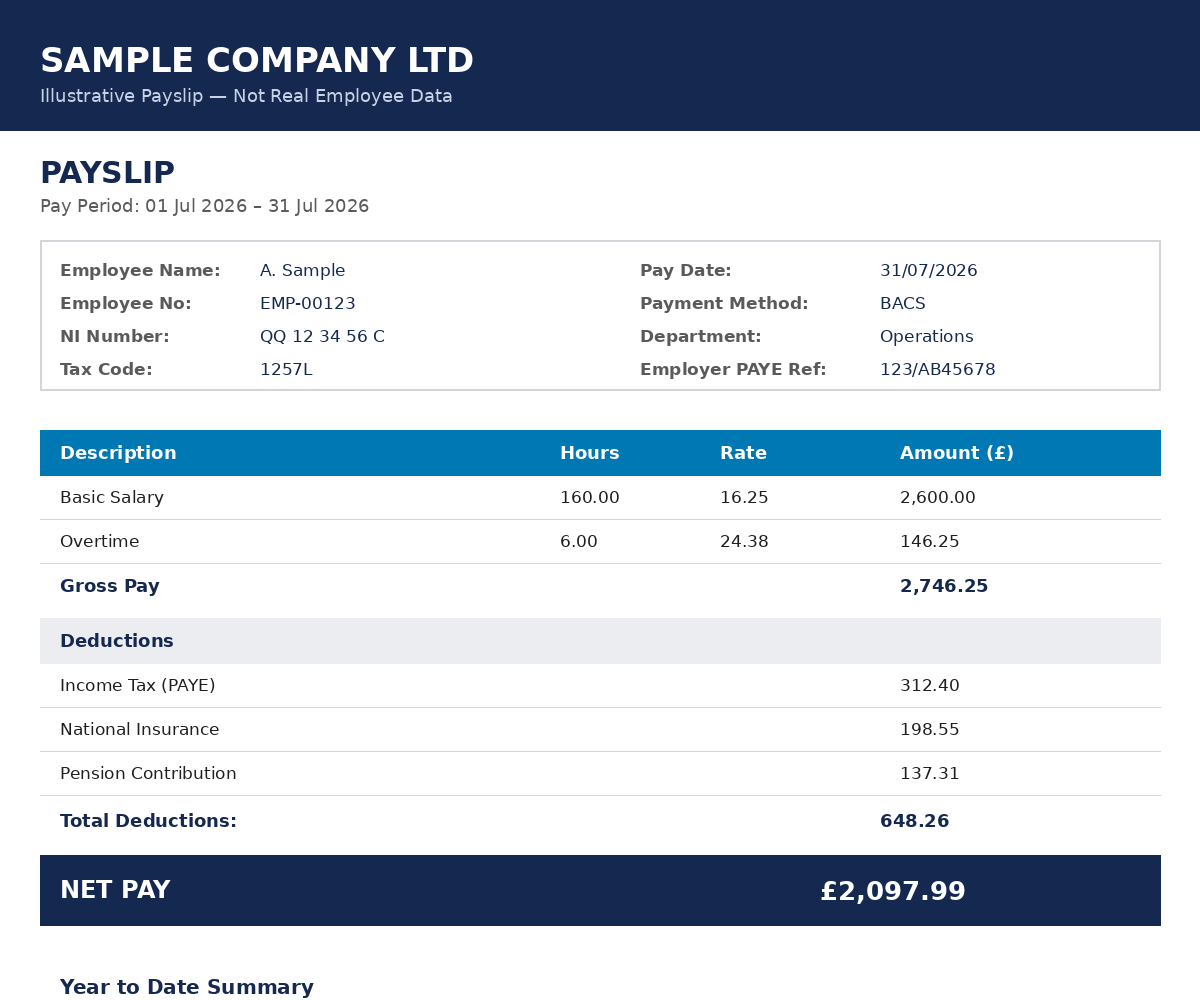
Identify these seven mandatory elements on every genuine payslip:
- Employer identifier: Company name, registered address, and PAYE reference number
- Employee identifiers: Full name, unique employee number, National Insurance designation
- Temporal markers: Exact payment date alongside covered pay period
- Earnings breakdown: Base salary, overtime, bonuses, commissions itemised separately
- Deduction schedule: Tax code, Income Tax amounts, NICs tier classification
- Aggregate totals: Year-to-date running balances for gross and net figures
- Payment method: Bank transfer details, cheque reference, or cash notation
Digital Storage Solutions That Actually Work
Prevention transcends cure. Implementing disciplined archival routines eliminates future panic surrounding lost payslips. Evaluate options against personal workflow requirements.
Cloud-Based Repository Systems
Distributed storage networks offer accessibility across devices plus automatic redundancy backups protecting against hardware failure.
| Platform | Free Tier Capacity | Paid Plans Starting Price | Encryption Standard |
|---|---|---|---|
| Google Drive | 15 GB | £1.99/month for 100 GB | AES 256-bit |
| Microsoft OneDrive | 5 GB | £2.00/month for 100 GB | BitLocker compatible |
| iCloud | 5 GB | £0.99/month for 50 GB | Apple end-to-end encryption |
| Dropbox | 2 GB | £9.99/month for 2 TB | AES 256-bit SSL |
| Proton Drive | 1 GB | €3.99/month for 500 GB | Zero-knowledge encryption |
Local Physical Archiving Techniques
Despite digital dominance, tangible backups maintain relevance for catastrophe recovery:
- Fireproof safes: Invest in UL-rated document containers resisting temperatures exceeding 1700°F
- Offsite storage: Store duplicates at trusted relatives' properties geographically distant from primary residence
- Lever-arch binders: Colour-coded dividers separating tax years enable rapid retrieval
- Microfilm scanning: Professional services digitise entire collections preserving originals
Employer Legal Duties Explained
Obligations extend beyond simply issuing monthly paperwork. Organisations bear ongoing responsibilities safeguarding historical payroll accessibility.
Mandatory Record Retention Timelines
| Record Type | Statutory Minimum | Industry Best Practice | Rationale |
|---|---|---|---|
| Basic payroll registers | 3 years | 6 years | Aligns with Limitation Act 1980 |
| National Insurance records | 4 years | Indefinite | Pension entitlement verification |
| PAYE submission logs | 3 years | 6 years | HMRC investigation windows |
| Employee expense claims | 5 years | 7 years | Corporation tax reconciliation |
Note: This post complements our separate article covering general payslip recovery. For broader options, read our comprehensive Get My Payslips guide instead.
Transfer Protocols During Mergers and Acquisitions
Business combinations trigger complex data handover obligations. Acquired companies' payroll archives must transfer alongside personnel files. HR departments should establish:
- Complete inventory mapping all legacy systems
- Format conversion plans maintaining data integrity
- Access permission matrices protecting privacy rights
- Communication templates notifying affected employees
- Contingency procedures for corrupted migrations
When Recovery Fails: Alternative Documentation
Occasionally, exhausted efforts yield empty-handed results. Defunct employers, destroyed records, and inaccessible systems force reliance upon secondary evidentiary materials.
Hierarchies of Substitute Proof
Not all alternatives carry equal evidential weight. Institutions accept substitutes variably depending on purpose and urgency.
| Substitute Document | Acceptance Level | Limitations | Ideal Use Case |
|---|---|---|---|
| P60 End-of-Year Certificate | High | Annual only, lacks monthly detail | Tax rebates, benefit claims |
| P45 Leaving Employment Form | Medium-High | Single snapshot, partial history | New job tax coding |
| Bank Statements (salary credits) | Medium | No deduction breakdown | Rental applications, loans |
| Employer Reference Letter | Medium | Self-reported, unverifiable | Background checks |
| Contract of Employment | Low-Medium | Promises rather than actuals | Dispute evidence |
Expert Answers to Common Questions
What should I do immediately after discovering lost payslips?
Act swiftly by contacting your payroll or HR department first. Send a written email requesting copies of specific pay periods. Simultaneously check your email archives, payroll portals, and mobile apps. If your employer has ceased trading, submit a Subject Access Request under GDPR and prepare to contact HMRC for a Statement of Earnings as a backup option.
Will mortgage lenders accept P60 instead of payslips?
Most mortgage lenders prefer recent monthly payslips covering 3-6 months rather than an annual P60. However, some specialist lenders will accept a P60 combined with 6 months of bank statements showing salary deposits. Always confirm specific requirements with your mortgage broker early in the application process to avoid unnecessary delays.
Can former employees access historical payslips online?
This depends entirely on the employer's policies. Some companies maintain permanent portal access for ex-staff members, while others revoke login credentials immediately upon termination. Former employees should contact their previous payroll department directly. If access is denied, they may need to rely on bank statements, P45 forms, or request an earnings summary from HMRC.
How much does it cost to replace lost payslips in the UK?
Receiving replacement payslips from your current or former employer should be free of charge. However, if you use third-party reconstruction services, expect fees between £5-£30 per document. Beware of fraudulent companies that create fake payslips — this constitutes fraud and can lead to criminal prosecution. Legitimate replacement comes directly from your employer's payroll system.
Does HMRC provide certified copies of old payslips for court proceedings?
HMRC does not store or certify individual payslip documents. For legal proceedings, they can issue a Statement of Earnings showing recorded income and tax deductions from their PAYE database. This document carries official weight in tribunals but differs from traditional payslips. Employers remain the primary source for authentic payslip copies for court evidence.
Final Thoughts
Lost payslips occasion frustration, yet rarely prove insurmountable obstacles. Methodical application of the six recovery techniques outlined herein resolves ninety percent of cases. Current employees hold overwhelming advantage through direct payroll access. Former workers require persistence coupled with alternative documentation strategies.
The critical lesson transcends reactive measures: cultivate proactive archival habits from day one of employment. Five minutes invested downloading and filing each payslip prevents dozens of hours troubleshooting absence later. Digital ecosystems facilitate effortless duplication and remote accessibility. Physical archives demand periodic maintenance but provide psychological reassurance.
Ultimately, lost payslips exemplify broader principles governing financial literacy and record stewardship. Treat wage documentation as living assets requiring regular attention rather than disposable ephemeral clutter. This mindset shift transforms administrative burden into strategic advantage empowering informed financial decision-making throughout career trajectories.
Disclaimer: This article provides general information only and does not constitute professional legal, tax, or financial advice. Regulations evolve periodically. Consult qualified specialists for circumstances-specific guidance. Last revised: August 2026.
Further Reading Resources: